Money is one of the most influential inventions in human history. It shapes economies, enables trade, defines wealth, and affects nearly every aspect of daily life. From buying basic necessities to managing global financial systems, money plays a central role in how societies function and grow.
Yet money is not static. Its form, function, and meaning have evolved over time, adapting to technological advances, cultural shifts, and economic needs. As digital payments, cryptocurrencies, and central bank digital currencies emerge, many people are asking an important question: what is the true function of money, and what does its future look like?
This article explores the fundamental functions of money, how those functions developed, and how they may change in the future. Written in clear, natural English, this guide is designed to educate readers while remaining SEO-friendly and compliant with Google AdSense standards.
What Is Money?
At its most basic level, money is a tool that people use to facilitate exchange. Instead of directly trading goods or services, individuals use money as an intermediary that represents value.
Money can take many forms, including coins, paper notes, bank deposits, and digital balances. Regardless of its form, money exists because people collectively agree that it has value and can be used to settle transactions.
This shared trust is the foundation of every monetary system, past and present.
The Historical Evolution of Money
Before money existed, people relied on barter systems. Goods and services were exchanged directly, such as trading grain for tools or labor for livestock. While barter worked in small communities, it became inefficient as economies grew.
The introduction of commodity money, such as gold, silver, or shells, solved many problems of barter. These items were durable, divisible, and widely accepted.
Over time, metal coins, paper money, and eventually fiat currencies emerged. Fiat money has no intrinsic value but is backed by government authority and public trust. This evolution reflects humanity’s ongoing effort to improve efficiency and economic coordination.
The Primary Functions of Money
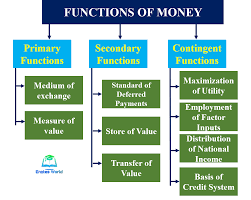
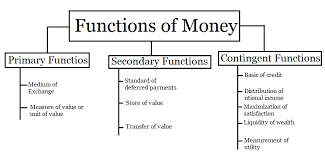
Economists traditionally describe money as serving three main functions: a medium of exchange, a unit of account, and a store of value. Each function plays a crucial role in economic stability and growth.
Understanding these functions helps explain why money is so important and how changes to monetary systems can affect societies.
Money as a Medium of Exchange
The most recognized function of money is its role as a medium of exchange. Money eliminates the need for barter by providing a common means through which goods and services can be traded.
With money, transactions become faster, more flexible, and more scalable. A person does not need to find someone who wants exactly what they offer; money allows value to be exchanged universally.
This function supports specialization and division of labor, which are essential for modern economic systems.
Money as a Unit of Account
Money also serves as a unit of account, meaning it provides a standard measure of value. Prices, wages, debts, and profits are all expressed in monetary terms.
This standardization makes it easier to compare the value of different goods and services. Without a unit of account, economic calculation would be extremely difficult.
By providing a consistent measurement system, money supports accounting, planning, and financial decision-making.
Money as a Store of Value
The third core function of money is to act as a store of value. Money allows people to save purchasing power for future use.
This function depends on stability. If money rapidly loses value due to inflation or instability, its usefulness as a store of value declines.
While no form of money perfectly preserves value over time, stable monetary systems help individuals and businesses plan for the future.
Additional Functions of Money
Beyond the three classic functions, money also serves as a standard of deferred payment. This allows debts and contracts to be defined in monetary terms over time.
Money also plays a social and psychological role. It represents success, security, and status in many cultures, influencing behavior and motivation.
These extended functions highlight how deeply money is embedded in social structures, not just economic systems.
The Role of Trust in Money
Trust is essential to the function of money. People accept money because they believe others will accept it in the future.
Governments, central banks, and financial institutions work to maintain this trust through regulation, monetary policy, and financial stability.
When trust erodes, as seen during hyperinflation or financial crises, the functions of money weaken, and alternative systems often emerge.
Money in the Modern Financial System
In modern economies, most money exists digitally rather than physically. Bank deposits, electronic transfers, and online payments dominate daily transactions.
Central banks manage money supply and interest rates to support economic stability. Commercial banks play a key role by creating money through lending activities.
This system allows economies to grow but also introduces complexity and risk, making effective regulation and oversight essential.
Inflation and the Changing Value of Money
Inflation affects how well money performs its functions, particularly as a store of value. Moderate inflation is often considered manageable, but high inflation erodes purchasing power.
When inflation rises, people may seek alternative stores of value such as property, commodities, or foreign currencies.
Understanding inflation is critical to understanding money’s limitations and the importance of sound monetary policy.
Digital Payments and the Transformation of Money
Digital technology has transformed how money is used. Cashless payments, mobile wallets, and online banking have become common worldwide.
These innovations improve convenience and efficiency while reducing transaction costs. They also raise concerns about privacy, security, and financial inclusion.
Despite these challenges, digital payments represent a significant shift in how money functions in everyday life.
Cryptocurrencies and Alternative Forms of Money
Cryptocurrencies introduced a new concept of money that operates without central authority. Built on blockchain technology, they aim to provide decentralized, transparent, and secure transactions.
While cryptocurrencies are still evolving, they challenge traditional ideas about money, trust, and control.
Their volatility limits their effectiveness as a store of value, but they demonstrate how technology can redefine monetary systems.
Central Bank Digital Currencies (CBDCs)
Central banks around the world are exploring digital versions of national currencies. Known as central bank digital currencies, or CBDCs, these aim to combine the benefits of digital payments with state-backed stability.
CBDCs could improve payment efficiency, enhance financial inclusion, and strengthen monetary policy tools.
However, they also raise questions about privacy, surveillance, and the role of banks in the future financial system.
The Future Function of Money
As technology advances, the core functions of money are likely to remain the same, but how those functions are fulfilled may change.
Money will continue to act as a medium of exchange, unit of account, and store of value, but digital systems may perform these roles more efficiently.
The challenge lies in balancing innovation with stability, ensuring that money remains trustworthy and accessible.
Money and Financial Inclusion
One important aspect of money’s future is financial inclusion. Digital systems have the potential to bring financial services to underserved populations.
Access to secure and affordable money systems can support economic growth and reduce inequality.
Designing inclusive monetary systems will be a key priority in the years ahead.
Privacy, Security, and Ethical Considerations
As money becomes more digital, concerns about data privacy and cybersecurity increase. Transactions leave digital footprints that can be tracked and analyzed.
Balancing convenience with personal freedom will shape public acceptance of future monetary systems.
Ethical considerations will play a growing role in how money is designed and governed.
The Global Nature of Money’s Future
Money is increasingly global. Cross-border payments, international trade, and digital currencies connect economies more closely than ever.
This interconnectedness creates opportunities but also increases vulnerability to global shocks.
Cooperation between nations and institutions will be essential to manage the future of money effectively.
Will Physical Cash Disappear?
While digital payments are growing, physical cash is unlikely to disappear entirely in the near future. Cash remains important for privacy, resilience, and accessibility.
Different societies will adopt new forms of money at different speeds, reflecting cultural and economic factors.
The future of money is more likely to be hybrid rather than entirely digital.
Adapting to the Future of Money
Individuals and businesses must adapt to changes in how money functions. Financial literacy will become increasingly important.
Understanding digital tools, managing risk, and staying informed will help people navigate evolving monetary systems.
Adaptability will be a key skill in the financial landscape of the future.
The Enduring Importance of Money
Despite changes in form and technology, money will remain central to economic life. Its functions enable cooperation, growth, and stability.
The future of money is not about replacing its purpose, but about improving how that purpose is fulfilled.
By understanding the function of money and its future, societies can make informed choices that support sustainable economic development.
Final Thoughts on the Function of Money and Its Future
Money is more than a means of payment; it is a reflection of trust, value, and collective agreement. Its functions have remained consistent even as its forms have evolved.
The future of money will be shaped by technology, policy, and human behavior. While challenges exist, opportunities for improvement and inclusion are significant.
By appreciating both the history and future potential of money, we gain a deeper understanding of its role in shaping the world we live in.
Word Count:
674
Summary:
A look at money and its evolution from barter to E-currency.
Keywords:
barter, trade, exchange, currency, ecurrency, money fund, invest, grow, global, economy, worldwide, ecommerce, trading, best, business, digital, innovative, internet, instant
Article Body:
Originally exchange took place without the use of money, by barter. Long before money had come into the commercial world people exchanged goods for goods. This system of barter made it possible to satisfy many wants that would otherwise have gone unsatisfied. Barter raised the standard of living, but under such a system the exchange of goods was greatly hampered. To barter requires that both buyer and seller need each other’s goods. Again, indivisible quantities hindered the exchange, since half a canoe or half a cow could not enter into barter. Nor was there under the barter system any standard of value. A ratio was expressed between canoes and arrows if they were traded for each other, but such an exchange gave no hint as to the ratio of bread to meet, or even of canoes to meet. Because of these disadvantages money was introduced into the commercial system as an intermediary, for which all goods could be sold and with which all goods could be bought. Thus money serves its first function, as a medium of exchange.
Money is a medium of exchange universally acceptable for goods and services. Originally the medium was the commodity most common in the trade of the time and place. Cattle served in Greece in the days of Homer. Grain, furs (in the Hudson Bay region), oil, salt, ivory, tea, wampum (among the American Indians), tobacco (in the colony of Virginia), and many other commodities served in various parts of the world as media of exchange. For them all things were sold; with them all things can be purchased. They were the money of the time. But gradually a tendency developed to use the metals, iron, copper, silver, and gold.
When first used the metal was not in the form of coins, but consisted of a certain weight. To guarantee the weight (and later the fineness) it became customary to stamp the metal with a government seal. We still have as the British standard coin, the pound, originally a pound of silver. But this stamp piece did not prevent “sweaters” from clipping off bits, and making the money short in weight. To prevent this, the seal or stamp was then affixed to both top and bottom of the piece. Sweaters then clipped the sides. Now coins are milled; that is, the sides are marked with corrugations to prevent clipping. Today money has come to consist of coins and cash that perform a function as a medium of exchange.
Under barter there is no standard of value, no least common denominator of values. With money we have a medium in which all values may be expressed, and money enters into its second function, to serve as a standard of value. Under a money regime we express all values in the commercial world in terms of a standard coin, in the United States in terms of dollars. With all goods related to one common standard, we know it wants the relation to one another of all commodities whose value is stated in money. If one product has its value stated as one dollar and the second as five dollars, we know that the ratio value of one to the other is one to five.
Money performs a further service. Borrowing and paying of debts has always constituted an important phase of commerce. The difficulty that we experience in using money as the standard of deferred payment is due to its instability and the change in its purchasing power. People are not interested in money, but in what it will buy. The purchasing power of money depends upon price level, which depending on government stability, changes drastically over periods of time.
The future for money in the global economy will enable quicker and more seamless transactions. Those with goods and services in countries worldwide will efficiently be able to process exchanges. As money continues to evolve so will its availability. The Internet is rapidly changing the face of money and with this change will come new opportunity to profit from it.


Tinggalkan Balasan